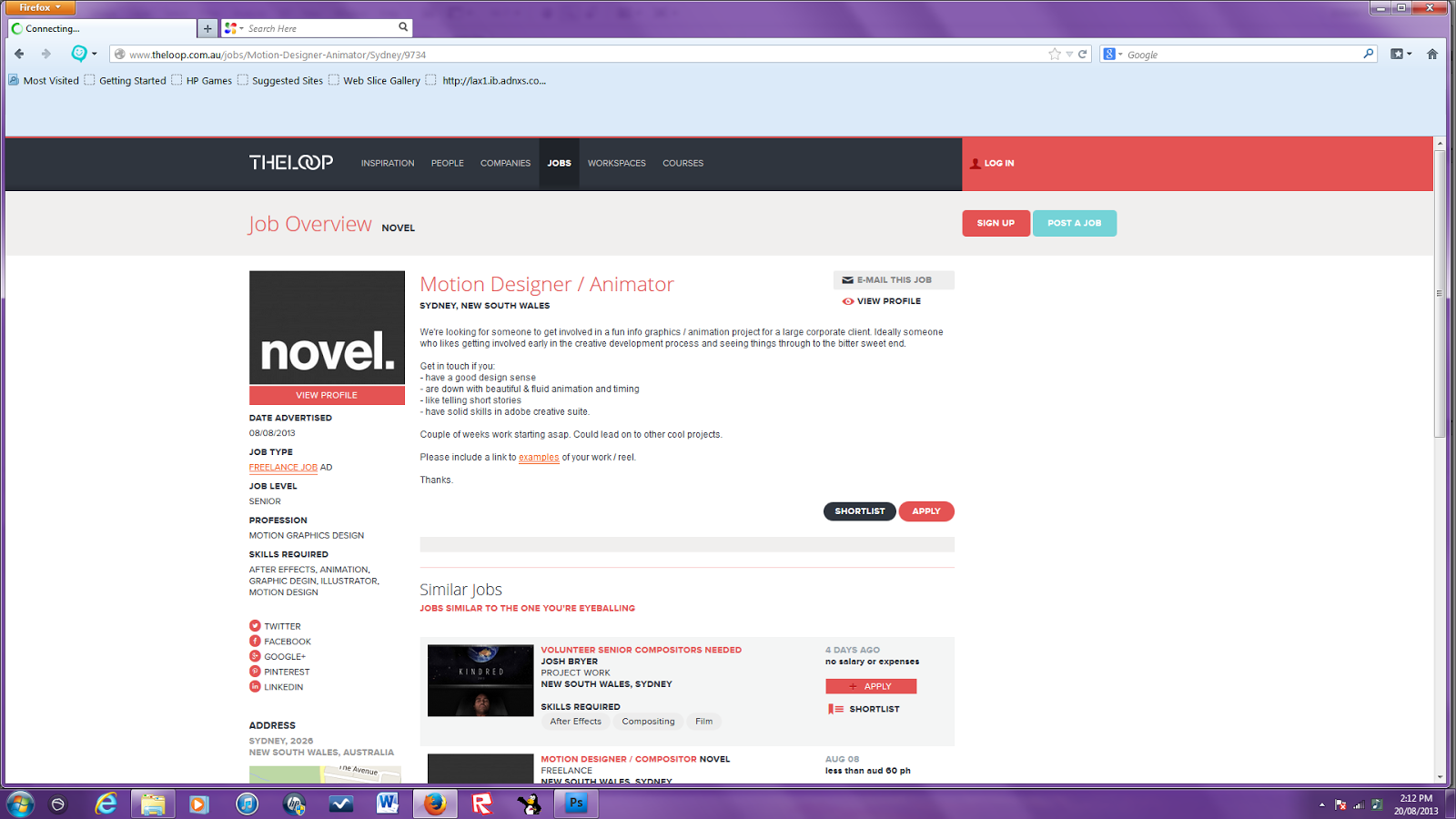
I managed to find twenty more Animation job opportunities advertised on a few different sites, several in Australia and some overseas. I mainly screen grabbed the ones concerning 2D, 3D, Vector, Internship, Freelance, full-time, compositing and animation. Also found some with Maya generalist as a requirement which I wouldn't mind applying for due to having skills in Maya from my studies at University.
Tuesday, 3 September 2013
Tuesday, 27 August 2013
Create a professional Resume or CV assignment part 2
This position is for a 2D Animator and to apply for it, I will chose the Chronological resume format.
The reason for this choice is the chronological format allows for more detail in describing duties performed in specific resume categories like employment experience.
I do lack in a couple of the requirements, Stop Motion and Final Cut. I however can make up for this with gaining a familiarity with Stop Motion from animation lectures and despite not being familiar with Final Cut, I can composite and create final edits with After Effects and Premiere Pro.
I can also learn Final Cut just in case it's a major requirement.
I believe I'm best suited for this role because I have gained various skills in more than one area and not just limited to one specific role. I'm also very flexible in given roles and willing to give anything new a try.
The reason for this choice is the chronological format allows for more detail in describing duties performed in specific resume categories like employment experience.
I do lack in a couple of the requirements, Stop Motion and Final Cut. I however can make up for this with gaining a familiarity with Stop Motion from animation lectures and despite not being familiar with Final Cut, I can composite and create final edits with After Effects and Premiere Pro.
I can also learn Final Cut just in case it's a major requirement.
I believe I'm best suited for this role because I have gained various skills in more than one area and not just limited to one specific role. I'm also very flexible in given roles and willing to give anything new a try.
Create a professional Resume or CV assignment part1
To begin, here is three resume examples for Animation positions.
Combination
Here's a sample of an animators Portfolio: http://animation.byu.edu/sample
An example of a professional Portfolio: http://www.kontrastiv.com/
http://www.habihanna.com
Functional: This example I found contained a lot of relevant information but only a couple of dates indicating the start of the qualification and employment history. It's a resume that contains the usual categories of qualifications, employment history, relevant accomplishments and education/training. It benefits greatly from having only the relevant information tailored for employment in the animation industry.
Chronological: I found this example to be my favourite. This resume goes into more detail on the duties performed in each category including the relevant experience, internship experience, technical summary and education. Everything has a year of when is occurred which shows how much years of experience has been attained. This resume is tailored for a Computer Graphics and Animation position and does contain the relevant information for that.
Combination: This is a resume tailored for a 3D Modeler and Animator position. This example is straight to the point and contains only the necessary information in dot points. Some employers prefer a more less detailed resume like this but does require the relevant information, which this example achieves quite well.
Unlike the chronological example, this resume doesn't include many dates like the functional resume example. I feel it could benefit from having more dates showing when each of these experiences occurred.
Here's a sample of an animators Portfolio: http://animation.byu.edu/sample
An example of a professional Portfolio: http://www.kontrastiv.com/
http://www.habihanna.com
Tuesday, 6 August 2013
Industry Sources-Research Project part 3
Software
In the Animation industry, having experience and knowledge with various programs is a requirement.
Software and equipment required for this particular job includes the following:
*Adobe Programs-
-Photoshop
-Flash
-After Effects
-Premiere Pro
-Illustrator
-SoundBooth
-Dreamweaver
*Autodesk Programs-
-Maya
-Mudbox
-MatchMover
-Softimage
-3Ds Max
-Toxik
-Combustion
*Blender
*ZBrush
Equipment
Equipment depends on the type of animation like 3D needing a really high powered computer, 2D requiring sketch pads/pencils if a hand drawn style, a Graphics Tablet if drawing digitally on the computer and Stop Motion needed a highly quality camera to take each frame, armatures for rigging, clay for molding characters and materials for building the environments like wire, cardboard and paper. These will be provided especially the computers and render farms required for the high quality productions. You can use your own computer if possible but it will need to have the appropriate license and not a free one found on certain websites.
Skills
Having the necessary skills in these programs from Intermediate to Advanced is a huge advantage to getting employment. Also knowing fundamentals of animation and demonstrating the ability to animate a character properly either key framing or inbetweening is also an requirement.
Appropriate education in the area is highly important and there are a few institutions that offer it like Charles Sturt University offering the Bachelor of Arts Animation Degree. Having a degree will at most times get your foot in the door, but promoting yourself to employers is also highly recommended. Having a showreel which showcases your work starting with the best projects you have completed to the least best. Having a personal website featuring your showreel, CV and resume is another more preferred means of promoting you skills.
Employment Locations
The location of employment in regards to Animation is mainly in bigger cities like Sydney, Melbourne and Brisbane in Australia. America is where the more well known production houses are like Dreamworks, Pixar and Disney.
If your located a distance away like maybe five hours then you can still work long distance and able to take time to travel if required to, so you don't have to be living in the same city to be employed in animation as work progress can be sent via the internet.
Challenges
Working on an animated project is filled with challenges. It is a time consuming process filled long work hours that can even lead to pulling an all nighter. Even with proper time management, a production can be worked on to the very last minute. It is never easy but despite this is fun and rewarding to see a final edit that turned out as planned. The challenge starts form day one to the final moments of completing a production, for example developing a concept, getting that idea across to the concept artists, translating the 2D concept sketches over to 3D which is a challenge to get the aesthetics correct, building the rigs that can lead to many problems especially if controls or joints aren't grouped right, animating can also be very challenging if the rigs aren't animator friendly, renders failing or lighting not being correct which can be avoided if test renders were made prior and compositing all the elements and layers together.
Creative Control
In regards to creative control, it depends on your role. If you're a director, you have a lot of control since it's technically your idea. However if you are given the role of assets creation then you will have to model based on the concepts and designs.
The one time you do have creative control is if your freelance in some cases but if working for a client, then they will have more control than you. Also producing your own for a personal production that you want to submit in a festival, screening or assessment then you will have substantial amount of creative control. In a sense it all depends on your role and profession in the field.
In the Animation industry, having experience and knowledge with various programs is a requirement.
Software and equipment required for this particular job includes the following:
*Adobe Programs-
-Photoshop
-Flash
-After Effects
-Premiere Pro
-Illustrator
-SoundBooth
-Dreamweaver
*Autodesk Programs-
-Maya
-Mudbox
-MatchMover
-Softimage
-3Ds Max
-Toxik
-Combustion
*Blender
*ZBrush
Equipment
Equipment depends on the type of animation like 3D needing a really high powered computer, 2D requiring sketch pads/pencils if a hand drawn style, a Graphics Tablet if drawing digitally on the computer and Stop Motion needed a highly quality camera to take each frame, armatures for rigging, clay for molding characters and materials for building the environments like wire, cardboard and paper. These will be provided especially the computers and render farms required for the high quality productions. You can use your own computer if possible but it will need to have the appropriate license and not a free one found on certain websites.
Skills
Having the necessary skills in these programs from Intermediate to Advanced is a huge advantage to getting employment. Also knowing fundamentals of animation and demonstrating the ability to animate a character properly either key framing or inbetweening is also an requirement.
Appropriate education in the area is highly important and there are a few institutions that offer it like Charles Sturt University offering the Bachelor of Arts Animation Degree. Having a degree will at most times get your foot in the door, but promoting yourself to employers is also highly recommended. Having a showreel which showcases your work starting with the best projects you have completed to the least best. Having a personal website featuring your showreel, CV and resume is another more preferred means of promoting you skills.
Employment Locations
The location of employment in regards to Animation is mainly in bigger cities like Sydney, Melbourne and Brisbane in Australia. America is where the more well known production houses are like Dreamworks, Pixar and Disney.
If your located a distance away like maybe five hours then you can still work long distance and able to take time to travel if required to, so you don't have to be living in the same city to be employed in animation as work progress can be sent via the internet.
Challenges
Working on an animated project is filled with challenges. It is a time consuming process filled long work hours that can even lead to pulling an all nighter. Even with proper time management, a production can be worked on to the very last minute. It is never easy but despite this is fun and rewarding to see a final edit that turned out as planned. The challenge starts form day one to the final moments of completing a production, for example developing a concept, getting that idea across to the concept artists, translating the 2D concept sketches over to 3D which is a challenge to get the aesthetics correct, building the rigs that can lead to many problems especially if controls or joints aren't grouped right, animating can also be very challenging if the rigs aren't animator friendly, renders failing or lighting not being correct which can be avoided if test renders were made prior and compositing all the elements and layers together.
Creative Control
In regards to creative control, it depends on your role. If you're a director, you have a lot of control since it's technically your idea. However if you are given the role of assets creation then you will have to model based on the concepts and designs.
The one time you do have creative control is if your freelance in some cases but if working for a client, then they will have more control than you. Also producing your own for a personal production that you want to submit in a festival, screening or assessment then you will have substantial amount of creative control. In a sense it all depends on your role and profession in the field.
Industry Sources- Research Project Part 2
Creative Progress
The creative process involved in an animation production can be extremely immense and time consuming. This information I gained from my time studying the animation degree at university as a lot of information was covered in regards to the animation industry. Also during assignments which we worked through the process from start to finish excluding financial information which was covered during lectures.
This site also goes into detail on the production process: http://www.creativeskillset.org/animation/overview/article_3768_1.asp .
The process can be broken into three main stages of production:
*Pre-Production- This consists of the early development process following:
- A log line, a one sentence summary of the main plot. An example: A young cat attempts to gain the approval of an older street wise cat.
-A detailed plot summary and also a character bios for developing each character.
-Writing up the script which is the backbone for a production.
-A story board which must include the shots in a series of rough sketches.
-An Animatic, an animated version of the story board. Usually very rough and sketchy like the storyboard. This also helps in getting the frame count for each shot, important for rendering and animating, cutting out any unnecessary shots and managing the correct timing especially with audio.
Must show the scenes, shots and the actions like a character moving from point A to point B in a shot or not moving at all for example a close up with dialogue. Also needs the audio and soundtrack included for timing purposes.
-Audio and Soundtrack. During my time studying animation at CSU, we were told to allocate 50% of the production schedule towards this. This is due to how important audio can be for a production like giving that additional scare from atmospheric sounds, a sound track that adds more emotion to a scene like an up beat tune to a happy scene. Also realism with footsteps each time a character takes a step or the sound of running water. Audio must also be edited to remove unnecessary background interference and if the volume output needs adjusting.
-Concept art for developing a final look for characters and environment concepts which is done by the concept artists. Different films these days have a concept art section in the extra's menu especially animated films.
*Production- This process differs depending on the animation like whether its 2D, 3D/Computer Generated or Stop Motion.
-Developing the assets, including creating the matte painting backgrounds, modeling and adding textures to the characters and environments, rigging the characters which is a technical process in it's own right.
-Animating, the process involving a lot of time. Reason is due to the amount of refining, key framing out the animated sequence then the inbetweens added to give a move smoother look.
Most of the time will be spent animating and is important that rigs are made animator friendly, so all trouble shooting and rig test should be done prior to animating.
Also adding in the audio in the time line is extremely vital in getting the correct timing especially with lip synching and for sound effects like footsteps.
*Post Production- The process that involves the final stages of a production.
-Rendering out all completed shots and frames. Depending on the quality, this can take a ridiculous amount of time to render every frame out. Hours to days even years for all renders to be completed. It's extremely wise to have good time management and enough allocated to rendering shots.
-Compositing all shots together to get a final edit. Ideally compositing is done in After Effects which was done in the animation degree at CSU. The edit was then brought into Premiere Pro for adding title, audio and credits.
Depending on how high quality the final edit is, this can take some time to export out. Sometimes even errors can occur like the audio not exporting out, so time should be allocated to required trouble shooting.
Hours Worked
The total hours spent on an animation production is quite immense. Based on my experiences working on projects in the animation degree, we spent over 50 hours or more working on a project.
Each duty can take a while depending on the quality of the project. For huge productions like Avatar, its taken them around 10 years to finish it due to how high quality with the level of realism they were aiming for. This industry work is time consuming and despite short cuts taken to complete a task, will never be a quick, easy process. Despite this its a worth while experience working with like minded peers and completing a project to the best quality you hoped for.
Promotion/Future Aspects
This industry has a wide range of positions ranging from assets to animator roles. Usually a graduate or someone with basic knowledge and skills can start out as an intern for a company with beginner knowledge as basic requirement. There is a wide range of opportunities for example, internship, freelance and in an actual production for a company like Pixar or Animal Logic. Personally I'm seeking 2D character animation so freelance might be a future aspect for me.
Examples of Creative Work
http://www.awn.com/news/places/disney-sets-release-date-miyazaki-s-wind-rises
http://www.awn.com/news/television/cn-s-uncle-grandpa-wins-ratings-race
http://www.awn.com/news/technology/rovio-taps-aspera-angry-birds
http://www.awn.com/news/people/animator-richard-williams-kicks-academy-exhibit-oct-4
Here are some examples of 2D animated productions and events occurring. It explains the process and details for each project. Found on the animation world network website which has many more articles on different animation productions and is very informative and recommended to read.
The creative process involved in an animation production can be extremely immense and time consuming. This information I gained from my time studying the animation degree at university as a lot of information was covered in regards to the animation industry. Also during assignments which we worked through the process from start to finish excluding financial information which was covered during lectures.
This site also goes into detail on the production process: http://www.creativeskillset.org/animation/overview/article_3768_1.asp .
The process can be broken into three main stages of production:
*Pre-Production- This consists of the early development process following:
- A log line, a one sentence summary of the main plot. An example: A young cat attempts to gain the approval of an older street wise cat.
-A detailed plot summary and also a character bios for developing each character.
-Writing up the script which is the backbone for a production.
-A story board which must include the shots in a series of rough sketches.
-An Animatic, an animated version of the story board. Usually very rough and sketchy like the storyboard. This also helps in getting the frame count for each shot, important for rendering and animating, cutting out any unnecessary shots and managing the correct timing especially with audio.
Must show the scenes, shots and the actions like a character moving from point A to point B in a shot or not moving at all for example a close up with dialogue. Also needs the audio and soundtrack included for timing purposes.
-Audio and Soundtrack. During my time studying animation at CSU, we were told to allocate 50% of the production schedule towards this. This is due to how important audio can be for a production like giving that additional scare from atmospheric sounds, a sound track that adds more emotion to a scene like an up beat tune to a happy scene. Also realism with footsteps each time a character takes a step or the sound of running water. Audio must also be edited to remove unnecessary background interference and if the volume output needs adjusting.
-Concept art for developing a final look for characters and environment concepts which is done by the concept artists. Different films these days have a concept art section in the extra's menu especially animated films.
*Production- This process differs depending on the animation like whether its 2D, 3D/Computer Generated or Stop Motion.
-Developing the assets, including creating the matte painting backgrounds, modeling and adding textures to the characters and environments, rigging the characters which is a technical process in it's own right.
-Animating, the process involving a lot of time. Reason is due to the amount of refining, key framing out the animated sequence then the inbetweens added to give a move smoother look.
Most of the time will be spent animating and is important that rigs are made animator friendly, so all trouble shooting and rig test should be done prior to animating.
Also adding in the audio in the time line is extremely vital in getting the correct timing especially with lip synching and for sound effects like footsteps.
*Post Production- The process that involves the final stages of a production.
-Rendering out all completed shots and frames. Depending on the quality, this can take a ridiculous amount of time to render every frame out. Hours to days even years for all renders to be completed. It's extremely wise to have good time management and enough allocated to rendering shots.
-Compositing all shots together to get a final edit. Ideally compositing is done in After Effects which was done in the animation degree at CSU. The edit was then brought into Premiere Pro for adding title, audio and credits.
Depending on how high quality the final edit is, this can take some time to export out. Sometimes even errors can occur like the audio not exporting out, so time should be allocated to required trouble shooting.
Hours Worked
The total hours spent on an animation production is quite immense. Based on my experiences working on projects in the animation degree, we spent over 50 hours or more working on a project.
Each duty can take a while depending on the quality of the project. For huge productions like Avatar, its taken them around 10 years to finish it due to how high quality with the level of realism they were aiming for. This industry work is time consuming and despite short cuts taken to complete a task, will never be a quick, easy process. Despite this its a worth while experience working with like minded peers and completing a project to the best quality you hoped for.
Promotion/Future Aspects
This industry has a wide range of positions ranging from assets to animator roles. Usually a graduate or someone with basic knowledge and skills can start out as an intern for a company with beginner knowledge as basic requirement. There is a wide range of opportunities for example, internship, freelance and in an actual production for a company like Pixar or Animal Logic. Personally I'm seeking 2D character animation so freelance might be a future aspect for me.
Examples of Creative Work
http://www.awn.com/news/places/disney-sets-release-date-miyazaki-s-wind-rises
http://www.awn.com/news/television/cn-s-uncle-grandpa-wins-ratings-race
http://www.awn.com/news/technology/rovio-taps-aspera-angry-birds
http://www.awn.com/news/people/animator-richard-williams-kicks-academy-exhibit-oct-4
Here are some examples of 2D animated productions and events occurring. It explains the process and details for each project. Found on the animation world network website which has many more articles on different animation productions and is very informative and recommended to read.
Tuesday, 30 July 2013
Industry Sources- Research Project Part1
Industry Sources Research Project
Area Of Interest
An area of interest I've chosen within the Digital Media Industry is 2D & 3D Animation. The reason behind this choice is that having studied the Animation and Visual Effects Degree, I wish to further my knowledge on this area.
Research
The are many different resources out there in regards to Animation, mainly online but can also be found in Magazines and books.
Online sources of information will include a variety of sites:
*http://www.theloop.com.au/ - Contains are variety of job advertisements for Digital Media including Animation. This is also the main site I collected twenty jobs from.
*http://www.animallogic.com/- The main website for Animal Logic, a company located in Sydney. Site contains a Job listing and production information.
*http://www.siggraph.org/ - Siggraph's main website. The site features upcoming events, a digital library and the latest news and conferences. Another good source of information especially the digital library. Siggraph has also had programs featured in the International Animation Festival.
*http://www.awn.com/ - Animation World Networks main website. Contains two online magazines, Animation world magazine and VFXWorld magazine. Also was a job listing, up to date news, blogs, events departments and various information on other departments like Visual Effects, Commercials and Reviews. I consider this one of the most important resources out there for Animation.
Industry Sector
The industry sector animation is found in is mainly the creative media industry. My main goal for employment is in 2D character animation but I don't mind if it's 3D animation too. I don't mind at all about the industry it belongs to as it consists of a variety of different sectors but despite this, it's still a highly competitive industry for employment.
http://www.creativeskillset.org/animation/overview/
This site gives information on the industry and the type of productions you may find yourself employed in regards to animated content for example television, feature films, commercials, video games, animated shows and websites.
This site also goes into detail on the whole animation production process from start to finish, information on whose employed in animation in the UK and an overview of animation in general.
Ethical Issues
http://thesignificanceofanimation.blogspot.com.au/
This site blog site gives details on the different Ethical Issues in this industry.
Some works can even question or parody different issues like religion, ethics and even politics.
Alone or in a collaboration
This depends on you position whether your a freelance animator which will be mostly on your working on personal productions or employed for contract work with a company which will mostly involve team work with other people. Being employed for an actual company like Animal Logic will be collaborating with other people in different roles like rigging or animating to complete a production. Each section of the production need to work and communicate to each other efficiently to achieve the goal of completing a high quality production. I don't mind working in a collaboration or alone but I prefer an actual collaboration with like minded people which makes things that more fun without being alone and bored. Collaborating also means being able to work in a role your most efficient in while others work on the other roles saving you the pain of working in a role you don't like. This is a down side to working alone where you have to practically do everything by yourself even the roles you don't like completing like for example rigging or even audio.
Management
Depending on your role in the industry there is the Director who has the most creative freedom in a production since it's there vision being created, Producer who organizers and arranges specific matters of importance like making sure the director is fulfilling their responsibilities, the production chart, contacting voice actors, actors, audio experts and setting up the dates and time lines of when specific roles must be complete by. There's also the leaders of each station like the lead animator, modeler, rigger and texture artist. Technically it depends on your role if your leading people or just being apart of the team being lead. Personally I'd be satisfied with just being a part of the team since I'm not really into leading people unless I'm required to.
Average Yearly Salary
http://www.bls.gov/oes/current/oes271014.htm
This site shows the statistics of multimedia artists and animators in general. It has tables the display the wages for each industry sector in multimedia including animation but is for America.
http://www.payscale.com/research/AU/Job=Animator/Salary
Not as detailed but is for Australia. For an animator it's AU$39,731 - AU$117,343 total. This page also has job listings for animators 2D and 3D so it's a pretty informative site to explore if job searching for animation employment.
Area Of Interest
An area of interest I've chosen within the Digital Media Industry is 2D & 3D Animation. The reason behind this choice is that having studied the Animation and Visual Effects Degree, I wish to further my knowledge on this area.
Research
The are many different resources out there in regards to Animation, mainly online but can also be found in Magazines and books.
Online sources of information will include a variety of sites:
*http://www.theloop.com.au/ - Contains are variety of job advertisements for Digital Media including Animation. This is also the main site I collected twenty jobs from.
*http://www.animallogic.com/- The main website for Animal Logic, a company located in Sydney. Site contains a Job listing and production information.
*http://www.siggraph.org/ - Siggraph's main website. The site features upcoming events, a digital library and the latest news and conferences. Another good source of information especially the digital library. Siggraph has also had programs featured in the International Animation Festival.
*http://www.awn.com/ - Animation World Networks main website. Contains two online magazines, Animation world magazine and VFXWorld magazine. Also was a job listing, up to date news, blogs, events departments and various information on other departments like Visual Effects, Commercials and Reviews. I consider this one of the most important resources out there for Animation.
Industry Sector
The industry sector animation is found in is mainly the creative media industry. My main goal for employment is in 2D character animation but I don't mind if it's 3D animation too. I don't mind at all about the industry it belongs to as it consists of a variety of different sectors but despite this, it's still a highly competitive industry for employment.
http://www.creativeskillset.org/animation/overview/
This site gives information on the industry and the type of productions you may find yourself employed in regards to animated content for example television, feature films, commercials, video games, animated shows and websites.
This site also goes into detail on the whole animation production process from start to finish, information on whose employed in animation in the UK and an overview of animation in general.
Ethical Issues
http://thesignificanceofanimation.blogspot.com.au/
This site blog site gives details on the different Ethical Issues in this industry.
- Intellectual property: This is the same as copyright laws where respect must be given to another work and to never copy it. This is somethings that must be avoided at all costs unless on a public domain and not self-owned by another.
- Image content: Another form of Intellectual property. This involves the use of similar materials to another production which can be difficult to interpret and thus leave a company with a bad reputation.
- Non-disclosure: The tight security placed on early concepts like storyboards and scripts. This prevents any production from being stolen.
- Business Ethics: This industry is changing in regards to this where it's increasing its focus.
Some works can even question or parody different issues like religion, ethics and even politics.
Alone or in a collaboration
This depends on you position whether your a freelance animator which will be mostly on your working on personal productions or employed for contract work with a company which will mostly involve team work with other people. Being employed for an actual company like Animal Logic will be collaborating with other people in different roles like rigging or animating to complete a production. Each section of the production need to work and communicate to each other efficiently to achieve the goal of completing a high quality production. I don't mind working in a collaboration or alone but I prefer an actual collaboration with like minded people which makes things that more fun without being alone and bored. Collaborating also means being able to work in a role your most efficient in while others work on the other roles saving you the pain of working in a role you don't like. This is a down side to working alone where you have to practically do everything by yourself even the roles you don't like completing like for example rigging or even audio.
Management
Depending on your role in the industry there is the Director who has the most creative freedom in a production since it's there vision being created, Producer who organizers and arranges specific matters of importance like making sure the director is fulfilling their responsibilities, the production chart, contacting voice actors, actors, audio experts and setting up the dates and time lines of when specific roles must be complete by. There's also the leaders of each station like the lead animator, modeler, rigger and texture artist. Technically it depends on your role if your leading people or just being apart of the team being lead. Personally I'd be satisfied with just being a part of the team since I'm not really into leading people unless I'm required to.
Average Yearly Salary
http://www.bls.gov/oes/current/oes271014.htm
This site shows the statistics of multimedia artists and animators in general. It has tables the display the wages for each industry sector in multimedia including animation but is for America.
http://www.payscale.com/research/AU/Job=Animator/Salary
Not as detailed but is for Australia. For an animator it's AU$39,731 - AU$117,343 total. This page also has job listings for animators 2D and 3D so it's a pretty informative site to explore if job searching for animation employment.
Tuesday, 23 July 2013
Identify Opportunities Written Exercise 3.
Animation is a highly competitive industry to get employment especially in Australia. However there are ways to get noticed through promoting your own work, since having just Qualifications on paper may not be substantial enough.
Opportunities include entering your own work in a competition which can be found on many websites by just searching on Google.
Each year in May, The International Animation Festival comes to Wagga Wagga for three days. Many animation students world wide enter in their best animated films for people to view in the cinema. Only the best animations are chosen, but this is not the only thing this event has to offer in regards to opportunities. There is also the chance to catch up with other classmates, talk to other film makers for information and advice as some of the film makers are from independent collectives and even freelance animators.
What is now possible for me is to produce an animation with newly developed or perfected skills and submit it into a competition.
"A Lone Scar" is a 2D animation both my classmate and I collaborated on in 3rd year at university. Mostly some of the hand drawn frames and Matt painting backgrounds will be worked on, then I wouldn't mind submitting it into a competition. If not entered into a competition, then it will prove valuable in a Show reel.
Another method of promoting your skills is building your own personal website featuring your Show reel, CV, contact information and resume. Websites are usually the most preferred way an employer will want to see your skills and information.
What I can now do to continue on this pathway is studying this course, Interactive Digital Media. My main goal was to improve my skills in Web Design and build my own website to show case my work, but now I can also get skills in Game Development since I have an interest in playing games and love the idea of actually making games. Once I finish this course, I'll have improved chances of getting employment once I move to Melbourne.
Opportunities include entering your own work in a competition which can be found on many websites by just searching on Google.
Each year in May, The International Animation Festival comes to Wagga Wagga for three days. Many animation students world wide enter in their best animated films for people to view in the cinema. Only the best animations are chosen, but this is not the only thing this event has to offer in regards to opportunities. There is also the chance to catch up with other classmates, talk to other film makers for information and advice as some of the film makers are from independent collectives and even freelance animators.
What is now possible for me is to produce an animation with newly developed or perfected skills and submit it into a competition.
"A Lone Scar" is a 2D animation both my classmate and I collaborated on in 3rd year at university. Mostly some of the hand drawn frames and Matt painting backgrounds will be worked on, then I wouldn't mind submitting it into a competition. If not entered into a competition, then it will prove valuable in a Show reel.
Another method of promoting your skills is building your own personal website featuring your Show reel, CV, contact information and resume. Websites are usually the most preferred way an employer will want to see your skills and information.
What I can now do to continue on this pathway is studying this course, Interactive Digital Media. My main goal was to improve my skills in Web Design and build my own website to show case my work, but now I can also get skills in Game Development since I have an interest in playing games and love the idea of actually making games. Once I finish this course, I'll have improved chances of getting employment once I move to Melbourne.
Subscribe to:
Posts (Atom)